Pre-amble
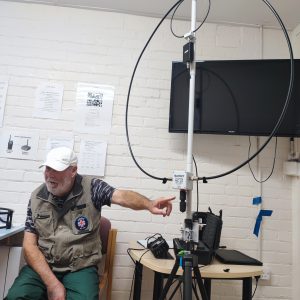
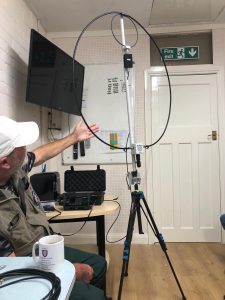
Following numerous enquiries from club members regarding his extensive use of magnetic loop antennas, Alan Henderson M0ZDD was invited to deliver a comprehensive presentation at the club house. During his talk, Alan provided detailed insights into his practical experiences with these compact antenna systems, offering a balanced assessment of both their significant advantages and inherent limitations.
Technical Demonstration and Equipment
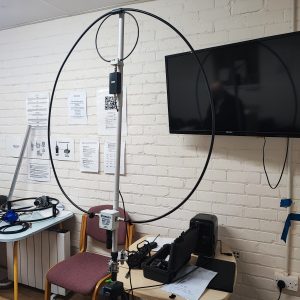
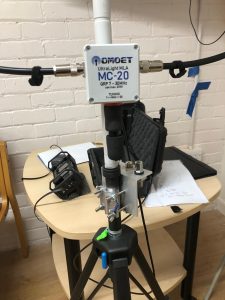
As part of the practical demonstration, Alan assembled a complete portable station featuring a tripod-mounted Xiegu X6100 QRP (low power) transceiver operating at up to 5 watts output power. This was coupled with an MC-20 magnetic loop antenna, an innovative design developed by OM0ET (Slovak Republic callsign), available through their website at https://om0et.com/. The MC-20 represents a commercial implementation of magnetic loop technology, offering operators a compact, efficient radiating system suitable for space-constrained installations and portable operations.
Homebrew Construction Guidance
Alan also addressed the construction of homebrew magnetic loop antennas, acknowledging the growing interest among radio amateurs in building their own systems. He particularly recommended the comprehensive online calculator provided by 66Pacific (https://www.66pacific.com/calculators/small-transmitting-loop-antenna-calculator.aspx) as an invaluable resource for operators interested in designing optimised magnetic loops. This calculator assists in determining critical parameters such as loop circumference, coupling loop dimensions, tuning capacitor requirements, and expected radiation resistance values.
Technical Benefits and Limitations
Throughout the presentation, Alan discussed the key technical characteristics of magnetic loop antennas, including their extremely low noise reception capabilities, sharp directional nulls for interference rejection, and minimal ground interaction. He also addressed their limitations, such as narrow operational bandwidth requiring frequent retuning, high Q-factor sensitivity, and the requirement for high-voltage variable capacitors in transmitting applications.
Faraday Sheet Implementation
To conclude the technical demonstration, Alan showcased the practical application of a Faraday sheet (RF screening material) within his portable operating configuration. He noted its proven effectiveness in reducing unwanted RF coupling and electromagnetic interference, particularly valuable when operating in electrically noisy environments or in close proximity to electronic devices.
Member Reception and Engagement
The presentation was exceptionally well received by club members, generating extensive discussion and numerous technical questions from attendees. The interactive nature of the session allowed for practical examination of the equipment and detailed discussion of implementation considerations for various operating scenarios.
Our sincere appreciation goes to Alan Henderson, M0ZDD, for generously sharing his extensive knowledge and practical experience with magnetic loop antenna technology. His presentation provided valuable insights delivered in an engaging and highly informative manner, contributing significantly to the club’s ongoing technical education programme.
Technical Terms Explained:
- QRP: Low power operation, typically 5 watts or less
- Magnetic Loop: Small, highly efficient antenna consisting of a loop of conductor with a tuning capacitor
- Q-factor: Quality factor indicating the bandwidth characteristics of a tuned circuit
- Radiation Resistance: The theoretical resistance that would dissipate the same power as radiated by the antenna
- Faraday Sheet: Conductive screening material used to block electromagnetic fields
- RF Coupling: Transfer of radio frequency energy between circuits or components